Tree Rotation: How AVL & Red-Black Trees Self-Balance
CMU Red-Black Tree Lab Insights
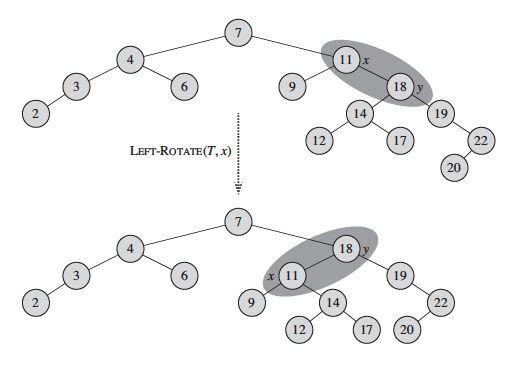
Summary
For a balanced binary search tree (e.g. AVL, Red-Black) to stay balanced, it has to enforce certain constraints that keep the tree height near log(n). The specific constraints differ between AVL and Red-Black, but both rely on tree rotation as the underlying primitive for restoring balance.
Base Structure
1
2
3
4
5
6
class Node():
    def __init__(self, data):
        self.data = data
        self.parent = None
        self.left = None
        self.right = None
Rotation
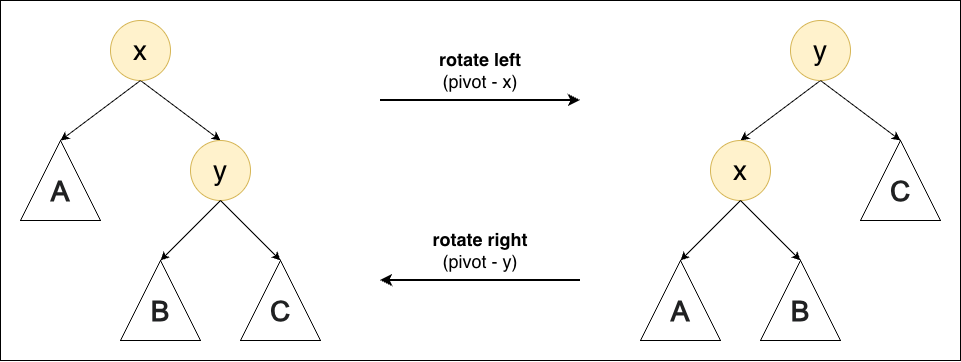 Tree rotation preserves the in-order traversal
This invariant — that rotation preserves the in-order traversal — is what makes rotation safe to use as a building block: any tree that comes out of a rotation is still a valid BST, so balancing logic only has to worry about height, never about correctness.
1
2
3
4
5
6
7
8
9
10
11
12
13
14
15
16
17
18
19
20
21
22
23
24
25
26
27
28
29
30
31
32
33
34
35
36
37
38
39
40
# TNULL is the Red-Black sentinel (always BLACK). For just the
# rotation primitive shown here, you could replace it with None.

def rotate_left(self, curr):
    r = curr.right
    curr.right = r.left

    if r.left != self.TNULL:
        r.left.parent = curr

    r.parent = curr.parent

    if curr.parent == None:
        self.root = r
    elif curr == curr.parent.left:
        curr.parent.left = r
    else:
        curr.parent.right = r

    r.left = curr
    curr.parent = r

def rotate_right(self, curr):
    l = curr.left
    curr.left = l.right

    if l.right != self.TNULL:
        l.right.parent = curr

    l.parent = curr.parent

    if curr.parent == None:
        self.root = l
    elif curr == curr.parent.right:
        curr.parent.right = l
    else:
        curr.parent.left = l

    l.right = curr
    curr.parent = l
Cases for Rotation
All cases below assume the right subtree is heavier (deeper), so each one rebalances by shifting weight to the left. The mirror cases (left-heavy) work symmetrically by swapping
left/rightin the logic.In standard AVL terminology: Cases 1 and 2 are both “right-right” (RR) patterns — handled by a single left rotation — distinguished here by whether the rotation changes the subtree’s root height. Case 3 is the “right-left” (RL) pattern, which needs a double rotation.
Case 1 — x height diff 2, y height diff 1
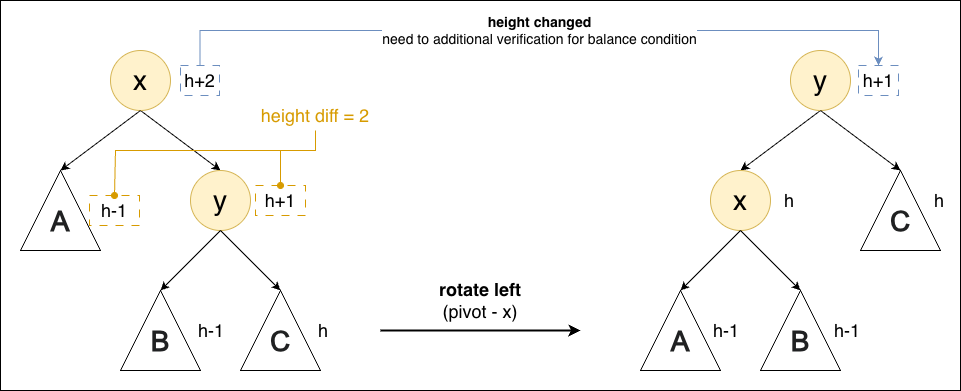 Case 1 —
 x is unbalanced (Δheight = 2); a single rotation rebalances x, but the subtree’s root height changed
From x’s point of view, the two subtrees below have a height difference of 2, which means a balancing procedure must run.
After the rebalance, the subtree root’s height has changed — so the procedure must recurse upward to check whether the rotation broke the parent subtree’s balance.
Case 2 — x height diff 2, y balanced
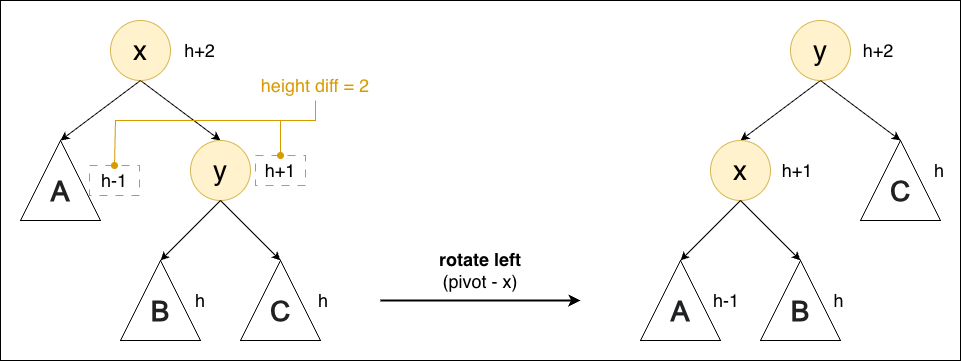 Case 2 —
 x is unbalanced (Δheight = 2); a single rotation rebalances and the subtree’s root height is unchanged
Same trigger as Case 1, but y is balanced (Δheight = 0). A single rotation rebalances the subtree, and the root height doesn’t change — so no recursion upward is needed; the parent subtree is unaffected.
Case 3 — single rotation isn’t enough; needs a double
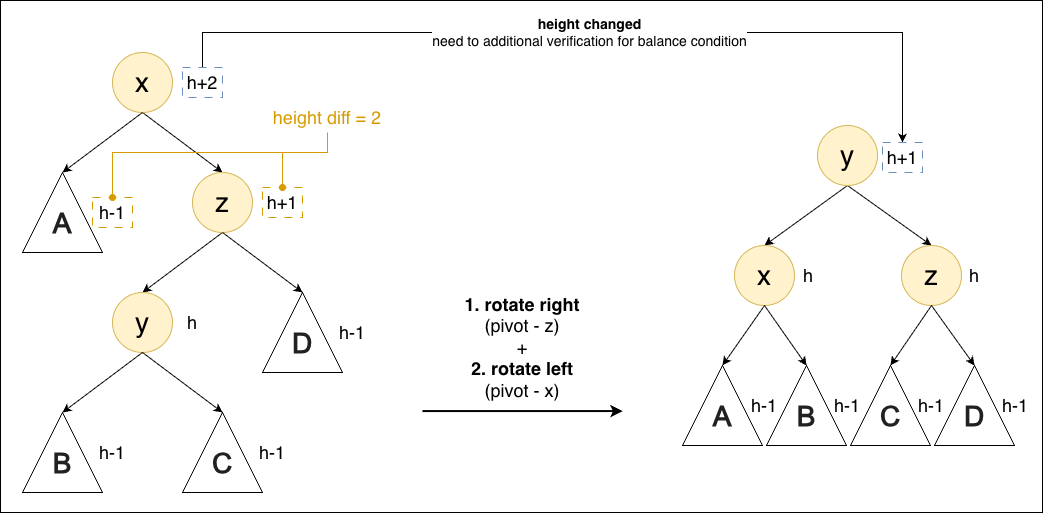 Case 3 — single rotation doesn’t fix the imbalance; needs a double rotation
Δheight is still 2 at x, but this time the shape is such that a single rotation would just move the imbalance to the other side. A double rotation is required: rotate the child first, then the parent.
As in Case 1, the subtree root’s height changes after rebalancing, so the procedure must recurse upward to check whether the rotation broke the parent subtree’s balance.